
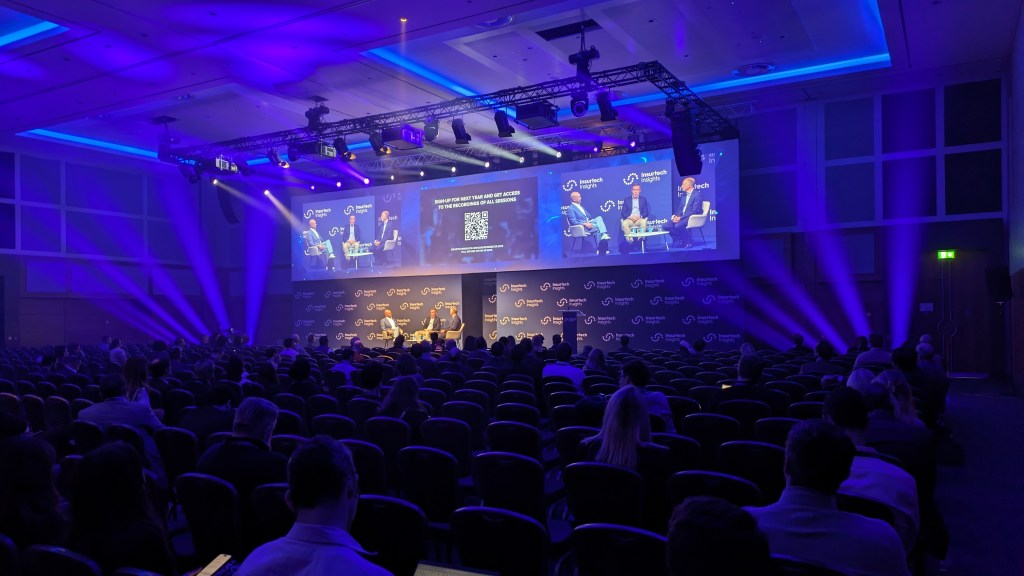
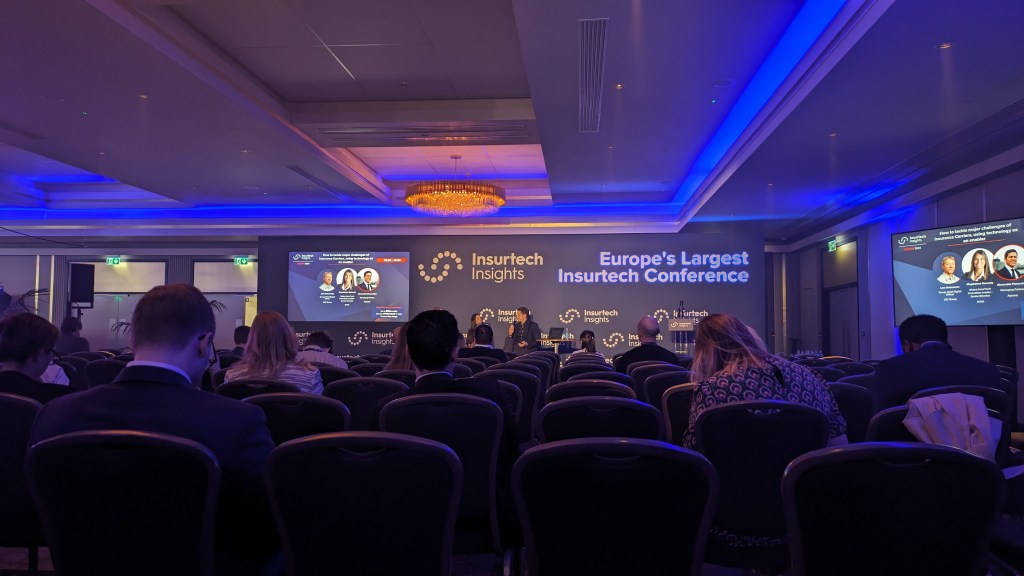
Back in March I attended the Insurtech Insights conference in London. It was a large two-day conference for insurers and technology companies, with thousands of attendees, hundreds of presentations and panel discussions, product demonstrations, and generally a lot of opportunities to meet insurance professionals from across the industry.
The theme of the event this year centred around AI, but there was much else of interest (perhaps to be covered in another post). I managed to fit in a total of eighteen talks across the two days, half of which drew some link to AI. I’ve summarised and made connections between all the talks to draw out what I interpret as the main considerations relating to AI in the insurance industry at the moment.

How will AI change insurance?
The first day’s presentations started off on a high-level note, with references to “The Singularity Is Near: when humans transcend biology” by Ray Kurzweil (2005). The title update for the sequel in 2024 says it all in terms of where Kurzweil thinks it’s going, “The Singularity is nearer: when we merge with AI”.
Effectively, we are rapidly moving towards computers being able to outperform humans in all areas. There was a lot of excitement about the topic, and a strong sense that despite a few confident sounding speakers, nobody knows for sure how it will ultimately affect the insurance industry, but it was interesting trying to guess and gather ideas.
Regulation
Some of the more mundane ways it will affect the industry include regulation, with the new EU AI Act recently introduced meaning insurers need to consider the scope of any AI being used within the EU, maintain technical documentation, and comply with copyright if scraping training data. It’s a strong start, and there are more acts to follow to deal with the issues of damages and compensation when AI causes harm.
Chatbots
One of the more obvious ways that AI is already being used is live chat bots that can interact with customers and answer basic queries with limited success depending on what you need. In the future this should improve to the point where the bots can access all prior conversations with customers and apply this knowledge to the current customer conversation, providing a much more tailored response.
Embedded insurance
In previous conferences the buzzword/phrase was “embedded insurance”. This is where the option to buy insurance along with something else you were going to buy anyway is shown to you at the checkout stage when buying online, and it aims to make insurance purchases seamless. This is still very much the goal in the industry, and AI will allow this to be tailored to customers and implemented more easily.
Data and coding
On the non-customer related side, existing LLMs like Chat GPT mean that we can expect AI to be able to translate policy wordings into different languages, translate code from one programming language to another, and write code for quick prototyping of app designs (something that has been around for a while with GitHub Copilot but will keep getting better).
pricing
AI should allow insurers to augment their existing data and connect disparate systems together more easily, potentially making pricing more efficient. One of the speakers, hyperexponential CEO and founder Amrit Santhirasenan suggested their pricing modelling approach was line of business agnostic. This could be the way forward for other companies if their data was more streamlined.
There is also talk of “democratising the model landscape”, where as a result of AI insurers would have access to a greater variety of models e.g. catastrophe models, where currently there are only a few specialist providers.
Are we all going to lose our jobs?
All the major concerns were addressed: AI sentience, mass unemployment, economic collapse, extinction of humans. Not really, but the sentiment seemed to be that AI will not replace us, merely become our intelligent assistant. Just as autopilot for airlines didn’t replace pilots, underwriters and actuaries were deemed to be safe as long as they keep their knowledge up to date.
The human touch
Insurers sell services to humans, and humans like the personal touch. For example, Allianz Direct use bots with Generative AI – but they need humans involved in order to get 5 stars from customers in their reviews. People don’t like non-personal communication and it’s easy to spot when an AI does it badly. Employees and customers will not like getting AI generated feedback either – it will need to be human-delivered to have the maximum positive impact.
Trust issues
There are early signs of a trust barrier rising since the public see the negatives of Google’s Bard (Gemini) and Chat GPT in the news and the risk of AI hallucinations. These LLMs were trained on general unmanaged data and as we know the internet has its patches of poor-quality information. LLMs built on restricted and specific insurance training data may work differently, but whether this will be better or create more bias is unclear.
The automation paradox
New technology has potential to create more work and new jobs. The automation paradox says the more work you give a machine, the more time you spend checking its output. AI will create vast amounts of output that needs checking before it gets used in insurance contexts.
To paraphrase hyperexponential CEO Amrit Santhirasenan, it’s infinite what we could do with our time once it is freed up by AI. AI will not make us redundant. The work is never over, and because work is also not finite, we won’t be replaced. Hopefully the employers also think that way.
The (current) problems with AI in insurance
I don’t doubt that many of the problems with AI will be addressed in some form in the future, but at the moment there seem to be more problems than solutions. As with any technology, it’s also being used by bad actors, and for insurers there is liability from the use and misuse of AI models – is it insurable?
Global issues
Governance is difficult. The EU’s AI act is notable for how impressive its scope is and how quickly it has been produced, but many frameworks globally still need writing and cannot really be country-specific if they are to be effective. Multinational insurers will have difficulties writing internal governance frameworks and complying with fragmented global regulations.
Ethical challenges
There is a lot of commentary saying that we are not ready for the ethical challenges. Fairness is a culturally local concept – a fair price for example might mean different things to different people. Transparency with customers remains important, and the decision making process needs to be clear to customers. With AI in pricing, it’s sometimes difficult to do the root-cause analysis needed. Having humans in the loop doesn’t guarantee there is no bias or unfairness.
Jumping ahead
A common refrain is that insurers should be making the best use of their existing data and improving their analytical capabilities. It’s all very well talking about new sources of insight from data, but insurers have not optimised or used 90% of the existing static data. We can’t simply leapfrog the problems by just using GenAI – there is still a need to put in the work.
Blunders
It’s easy to find examples of where chatbots have given the wrong advice to customers and the company was fined, but these examples are just the start of potentially more serious unintended misuses of the technology.
Data privacy and copyright risks abound as well. The CTO of OpenAI, Mira Morati, was asked about whether the company scraped YouTube videos to use as training data, which would violate YouTube’s terms of use. She said she didn’t know.
Why AI will be good for insurance
The above issues are not insurmountable, and there are many reasons to be positive.
Efficiency
If AI can automate many of the more mundane tasks, employees can focus on what they like to do and are good at, with the help of an AI assistant. The potential for underwriters and actuaries to use human language to question an entire corpus of underwriting data would be extremely valuable.
The freed-up time could also be spent on creative projects and opportunities to improve the business, or simply using the saved time for more personal learning and development. All of these benefit the business in ways that are measurable, especially in terms of efficiency gains – quicker debugging of code via Gen AI, better code quality, and code resilience is improved.
Customer satisfaction
There are also numerous benefits to the customers, where AI can make interacting with the customer easier, tailoring their experience and making them more likely to tolerate the purchasing process. Hyper-personalised marketing using generative AI could be more specific and relevant to customers, saving them time and money in their search for relevant cover.
Apps can provide a service to customers – AI curated videos and explanations of how to turn off water pipes etc. or suggested connections to approved plumbers and electricians and explaining what to do in a claim event. Then again, I’m fairly sure nobody really wants to download an insurance app, so integrating with insurance partners’ apps is also key for distributing the products effectively.
Summary and conclusions
The insurance industry has traditionally been a very slow-moving and antiquated industry. It has generally been a follower in terms of its adoption of new technologies. The conference speakers generally agreed that any use of Gen AI or new technical solutions should derive from the needs of the business, rather than simply the technology leading it.
On the other hand, insight is a better teacher than foresight – learning from failure is much more valuable than trying to predict what is going to happen, so insurers should embrace these changes and dive in with their implementation using their skills as experts in risk to ensure that we use them to the benefit of the industry and customers.
Let me know in the comments how you think the insurance industry will be affected by AI, and if there are other topics covered at the Insurtech Insights conference you’d like me to cover. Thanks for reading.
 Exploratory Finance
Leave a comment